Preventing Unscanned Items at Checkout with Vision-Based Cart Monitoring
Published on November 26, 2025 by TIS Marketing.
Reducing Shrinkage from Unscanned Items
A leading German supermarket chain with over 3000 stores in Germany faced a recurring challenge at checkout: items sometimes remained in the cart and were not scanned during checkout, resulting in annual losses estimated in the millions. Traditional checkout procedures, typically a brief visual inspection by cashiers, were insufficient for consistently detecting goods left in the cart.
Recognizing that improving loss prevention required automation, management partnered with an experienced machine-vision integrator to develop a reliable, vision-based inspection system. To meet the project's technical, spatial, and integration constraints, the integrator approached The Imaging Source.
Integrating Vision into an Existing Checkout System
The primary engineering challenge was to implement a high-reliability vision system within the extremely limited space available in the stores' checkout lanes, while ensuring robust communication with the retailer's existing checkout infrastructure. A USB 2.0 interface was selected to match the installed hardware environment and simplify integration into the cashier terminal.
Because the requirements were highly specific (tight mechanical constraints, defined optics, and image characteristics) a standard off-the-shelf camera was insufficient. The Imaging Source developed a custom OEM USB 2.0 board-level camera based on the Sony IMX290 color sensor within only a few weeks, optimized for the integrator's mechanical design and planned image-processing pipeline.
AI-Assisted Automated Cart Inspection
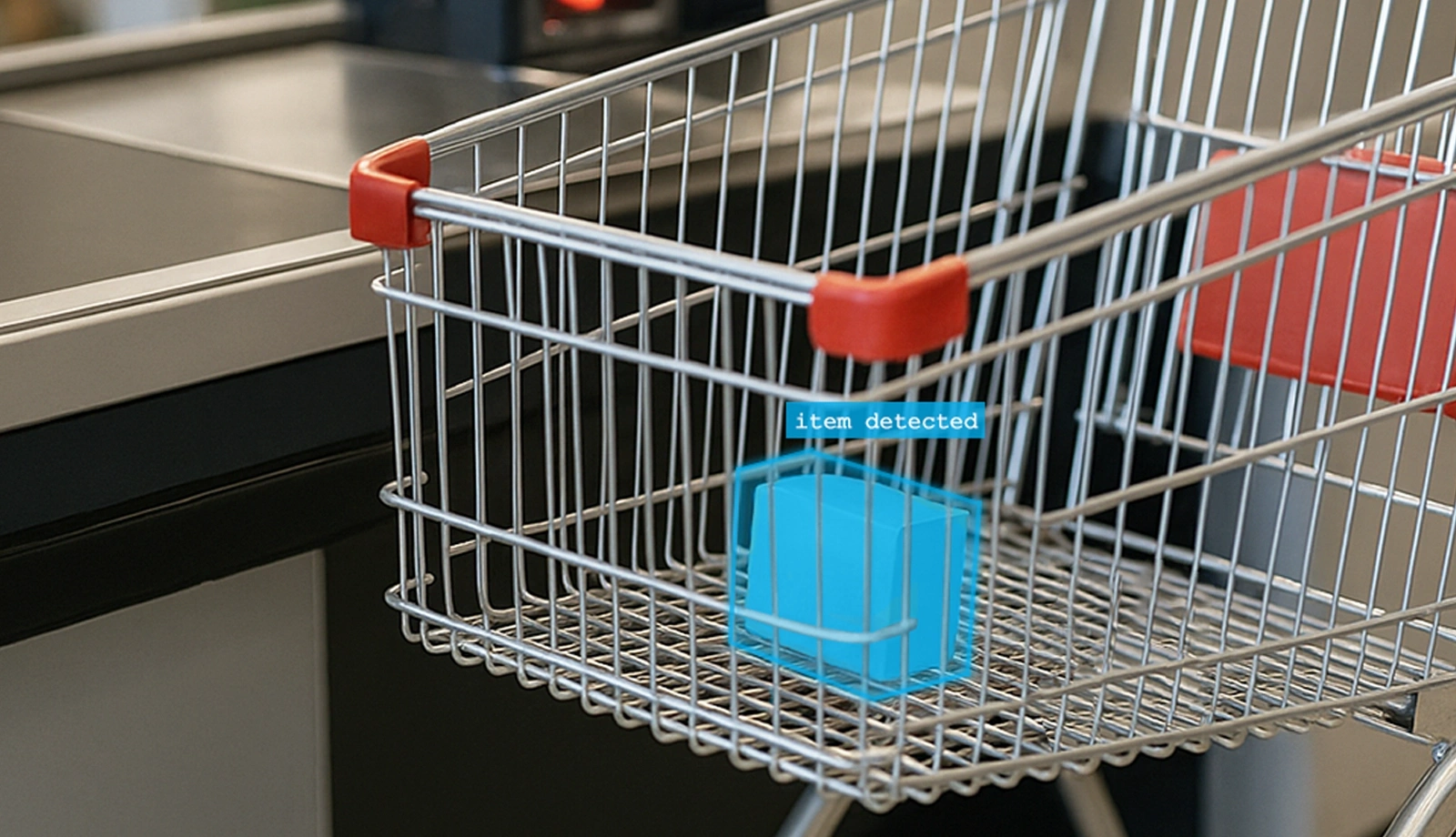
As each shopping cart passes through the checkout lane, The Imaging Source's OEM camera captures a high-contrast color image of the cart. The integrator's AI software immediately analyzes the image to determine whether items remain in the cart. If the AI detects goods, the cashier is notified via a color-coded signal and shown the corresponding image on the checkout screen or an optional external display.
Even at high frame rates and under challenging lighting conditions, the compact OEM camera delivers crisp, well-defined images that support robust AI inference on objects inside the cart. The integrator emphasized that The Imaging Source's SDK, responsive engineering and technical support, and the adaptability of the board-level design were key factors enabling rapid development and stable field performance.
Implementation and Key Features
-
Sharp, high-speed color imaging: Compact, robust OEM camera solution.
-
Straightforward integration: A "one system, one cable" concept allows quick connection to existing checkout hardware-system setup takes under five minutes.
-
Low maintenance: Designed for continuous, multi-shift retail operation with minimal service requirements.
-
Flexible display options: Alerts and images can be shown on cashier terminals or dedicated auxiliary monitors.
Results and Business Impact
Deployment of the cart-monitoring solution led to a substantial reduction in losses from unscanned items. In many stores, shrinkage associated with unscanned cart goods was nearly eliminated. The rapid decrease in preventable revenue loss generated a fast return on investment and improved checkout accountability.
Innovation in Retail Technology
The integrator showcased the complete AI-driven system at EuroCIS 2025, one of the leading global trade fairs for retail technology. The presentation highlighted the solution's role in advancing automated checkout monitoring and reinforced the integrator's position as an innovation leader supported by The Imaging Source's OEM imaging expertise.